A quick-reference comparison
The chart below provides a quick comparison of several commonly used 3D printing materials. It is intended as a practical starting point rather than a substitute for testing or project-specific recommendations. Actual performance can vary depending on the filament manufacturer, part design, wall thickness, infill, print orientation, layer adhesion, and operating environment.
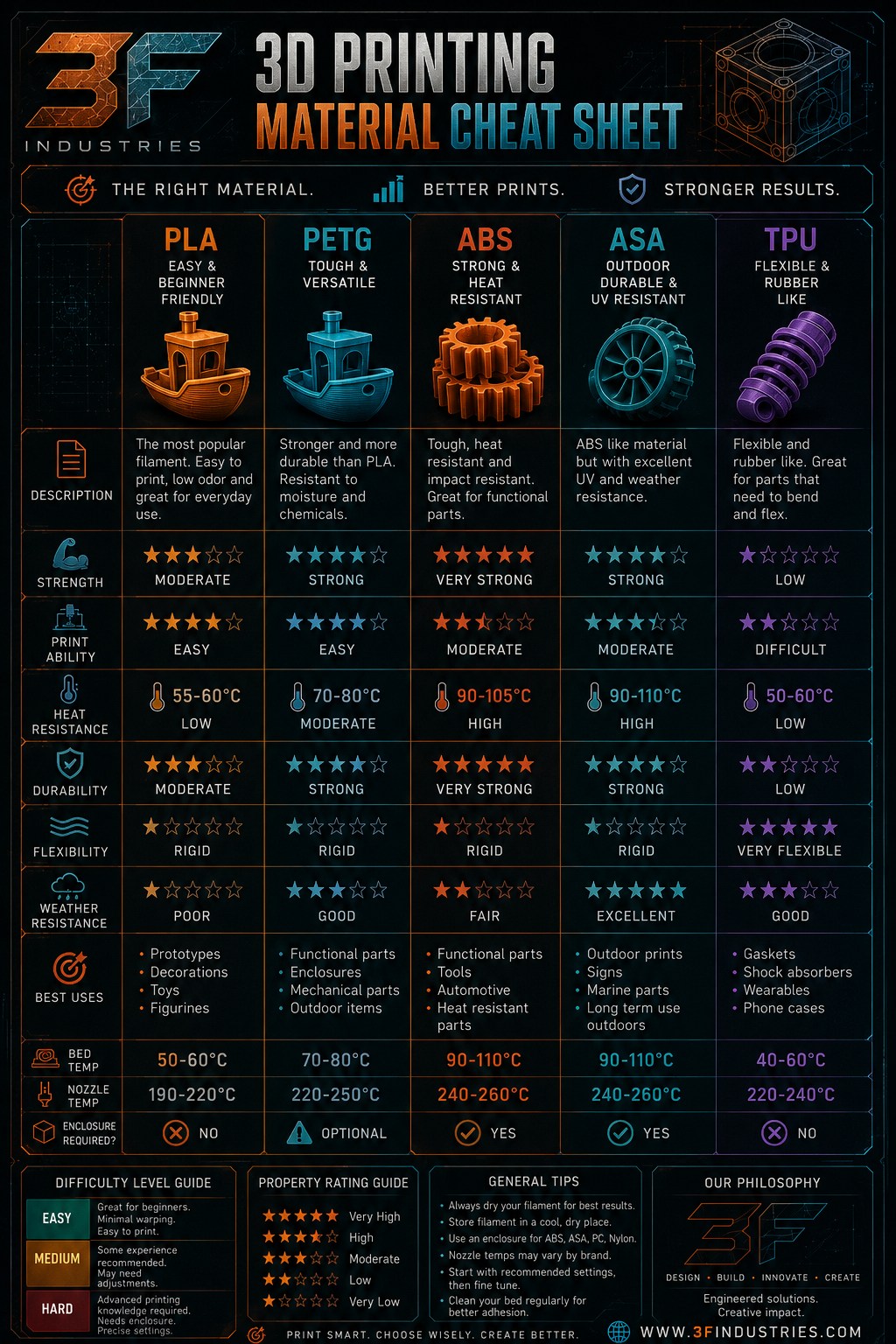
Picking the right material
Start by thinking about what the finished part needs to do. Consider whether it will be used indoors or outdoors, exposed to heat or moisture, placed under load, repeatedly handled, or required to bend or absorb impact. A material that works well for a decorative prototype may not be appropriate for a functional component.
For general indoor prototypes and display pieces, PLA is often a practical choice. PETG is a strong starting point for many functional parts. ABS and ASA are better suited for applications involving higher temperatures, with ASA offering improved outdoor performance. TPU is used when flexibility, grip, cushioning, or vibration resistance is needed.
Material choice is only part of the equation. Part geometry, print orientation, wall thickness, fastener placement, and expected loading can have just as much influence on the final result.
What 3D printing can't do
3D printing is useful for prototypes, replacement parts, custom tools, enclosures, fixtures, and low-volume production, but it is not the right process for every application.
Printed parts are built layer by layer, which means they may be stronger in one direction than another. Components exposed to heavy loads, repeated impact, pressure, extreme heat, or safety-critical conditions may require machining, metal fabrication, commercial hardware, or another manufacturing process.
Dimensional accuracy should also be considered. Holes, mating surfaces, snap fits, bearings, and threaded connections often require added clearance, test prints, or secondary finishing. Tight-tolerance parts may need machining after printing or may be better suited for CNC production from the beginning.
Build volume limits the maximum size of a single printed part. Larger components may need to be divided into sections and assembled with fasteners, adhesives, alignment features, or threaded inserts.
Surface layer lines are also a normal part of filament-based printing. Sanding, filling, priming, painting, or other finishing methods can improve appearance, but these steps add time and cost.
For structural, regulated, load-bearing, pressurized, food-contact, or life-safety applications, additional engineering, testing, or certification may be required.